THE
UNMUTUAL PRISONER ARTICLE ARCHIVE
THE PRISONER - ESCAPE TURNS
By Tony Sandy
SECTION ONE - IN TWO MINDS?
This and all that follows is a reaction to the third volume of Ed Fordham's epic work ‘It Means What It Says.' (available HERE).
What is 'Arrival' but awakening as a stranger in a stranger land. 'Where am I?' As John Drake Patrick McGoohan was typecast, trapped in a role and a way of life as a person. As no. 6 he suddenly developed a conscience and consciousness, and tried to escape. In his previous role he was guided by others (a hierarchy, an artificial structure) but as The Prisoner he revolted against being pushed around and directed by others.
This is really his transition from a member of the 'pillage' (a child) to an adult that questions his part in this way of life and its validity. The village wants him to betray himself and his principles (his integrity as an individual) but he'd rather be thought a fool for doing this than be one by ratting on himself. They want him to be a good (catholic) boy / a model citizen and do what he is told as he always did, so they try their best to break him.
In Fallout he finds this is not possible as he is shouted down by the committee, when he tries to assert his individuality, one last time ('I-I-I'). This is a case of judge not least yeah be judged or humility versus the ego. Perhaps open rebellion is not the way but keeping yourself to yourself is the way of maintaining your integrity. All wars and revolts replace one jealous dictator with another because that is the cat you let out of the bag, when you give up the struggle to remain and retain yourself as a being.
In the film Downfall, about Hitler's last days, there is a scene where some members of the bunker try to escape and pass through a beer hall. Those inside, who have given up the struggle, are lost in debauchery. This is a wonderful example of despair over some kind of hope in the two groups and indeed the villagers becoming like rotten cabbages because they too have given up the fight.
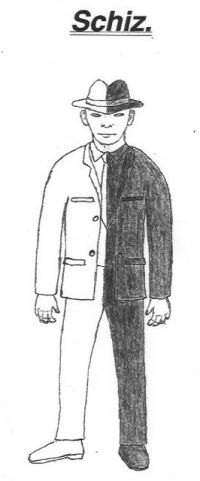
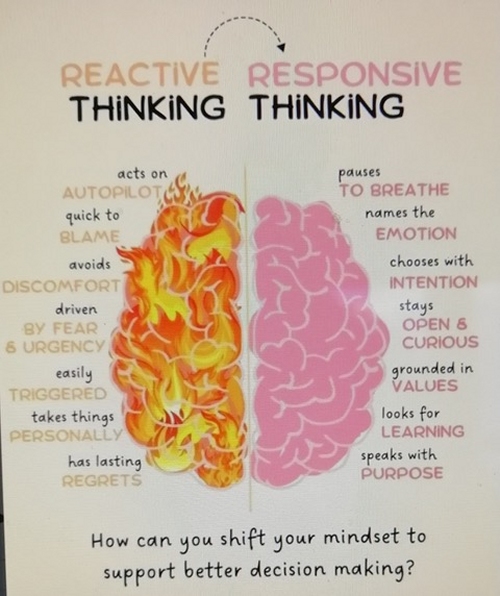
We're all binary - having a thinking, questioning side and an unthinking, reactive side; the obedient robot that does what it is told. A polite society keeps its head down and ponders life as opposed to a rude one that demands attention (fighting / cajoling everyone around it / rebelling against the status quo).
Politeness keeps people at a distance, whereas rudeness leads to conflict. In Kingsman: The Secret Service, ‘It was said that manners maketh the man. People think manners are for others. They are not. They are the cage you build for the animal inside.' In Fallout, the mayhem that follows number one's fall from grace and the collapse of the Village, reflects what happens, when the order and discipline that keeps a society in place, simply vanishes and chaos and confusion replace it. Politeness is a defence of the mind (intellect / thought) as rudeness is an emotional assault (verbal or physical) upon the senses: through silence and stillness we find ourselves as through noise and motion we lose ourselves.
Society's corruption is to be found in the innocent being scapegoated and the real criminals going unpunished - in other words the truth gets buried under lies to protect the guilty and divert people's attention from the situation: subjective lies versus objective truth. The pretence of virtue as opposed to the ugly reality of existence - taking our cut to stay silent (who dies for our sins? We do, inside).
At base these two parts are composed of an inner part that remembers the past (guilt) and another that imagines a redemptive future, free of sin (error terror). The outer world is the school playground, where we act out the latter unconsciously, while trying to suppress (imprison) the memories of past misdeeds. Our struggle with existence involves one side trying to drag us back into ourselves (conscience) and the other just trying to experience the (crazy) present and release our selves into the future.
Sometimes we can't move forward because we lack the energy to do so (running on empty), instead of accepting the reality we find ourselves in: we fight it but still get nowhere. This is the yinyang quandary of outer light / inner dark or The Tao of inner and outer journeying (conscious exploration of our thoughts or unconscious release of energy / attention). The reality is that the one feeds the other or thought (theory) leads to action (testing ideas against reality).
SECTION TWO - OUT OF HIS MIND?
This is a reaction to Howard Foy's entry into the book, examine the part that sixties culture played in all this, especially drug culture or lucid dreaming.
Number Two and Number Forty Eight as the two halves of reality (the seven ages of man, reduced to the start and the end - the rebellious youth and the conservative old man (page 116, paragraph 2). One at the start of his journey and the other seeing the end (not the start of the conveyor belt and the distant journey ahead but the edge of the abyss approaching). The General is all about conforming to a belief system (education or indoctrination?).
The paranoia of Number Two in Hammer into Anvil, is the fear of being discovered to be a fake and in this episode number Six is not only the avenging angel but the force trying to get Number Two to face himself and the ultimate reality of life, including ourselves, that is being blank canvases as long as we keep progressing through time instead of hiding from reality and fearing disclosure about our past.
There is no Number One. This is an illusion created by looking back upon the past (history) and thinking it is real because it is formed. Time wise the present is what we experience (the unknown future, the Undiscovered Country coming towards us - the strange, the different, the new) as the past is the snakes skin we have sloughed off and left behind. To quote The I-Ching ‘Before the beginning of something brilliant, there must initially be chaos (The Chrysalis Effect).
As for the blending of sensory data, look no further than synaesthesia, where this seems to be carried over into some individuals, during adult life (page 113, paragraph 4).
What about meeting the same character in two different roles, one after the other, radio repair man and gardener, seemingly in a time period that could not be real? Then there's Number Six being able to speak in a foreign language he didn't know plus twice electrical gear being destroyed yet still working (the radio in Arrival and the ticker tape machine in Dance of The Dead).
This speaks not only of drugs and altered states but a step into psychic reality, where the mind interacts with reality as poltergeist effects or precognition (card reading with Jane Merrow and the betrayal of this ability in Schizoid Man). There was a Popular Mechanics article that talked of psychedelic drugs being used to treat PTSD as it opened up the visual centre and quietened the verbal one (the inner critic): Psychedelic Experiences Unlock A Higher Level of Consciousness by Stav Dimitropoulos.
I, like Patrick McGoohan, I think have spent our lives high on ourselves as someone put it, not needing drugs. I tried cannabis twice, once it clarified my vision, the second time I ended up with verbal diarrhoea. Patrick McGoohan boxed as a schoolboy and as the saying goes ‘only the cracked let in the light,'which might explain him and me both, through something called Acquired Savant Syndrome (I haven't boxed but seem highly prone to have accidents which lead to blows to the head).
I wonder if this explains teachers hitting pupils and shouting at them to wake up? Are you aware of how many comics started off as boxers - Bob Hope, Tommy Cooper, Norman Wisdom, Charlie Drake etc (these last three boxed in the army and I think I may have forgotten others, whose biographies I read once upon a time).
I also had twenty years and more of migraines, which resulted in an eight volume series, breaking down language, Logic Lists English, plus two books of philosophical observations on the human condition (motives / agendas), which can be viewed on the Open Library or samples seen on https://www.deviantart.com/paigetheoracle/ and also on https://uk.pinterest.com/paigetheoracle.
I could also be on the autistic spectrum as I'm considered a bottom up thinker, not a top down one as with most people. In the phenomenal world, plants grow from the bottom, up. Animals start off as details (genes, eggs, cells) and the world is composed of atoms, that build up into molecules and diversify into different materials. Top down is looking at things from the standpoint of the finished product - the whole universe, the complete body, the end product, the finished material.
SECTION THREE - BOTH SIDES OF THE ARGUMENT
Reading the section on Lewin's forcefield analysis, a few thoughts occur. Firstly and most notably in a sport like boxing, you don't keep slogging at each other, until both sides collapse exhausted, you have rounds with breaks to recover in (round 1,2,3 etc). Perhaps No.2 as a position of authority is continually replaced, like in a wrestling tag match (on one side at least, so his opponent is worn down). Degree Absolute shows what happens when neither side is allowed to give in (a dual to the death).
The present has no filter. It is experienced in the raw (it is like 2001, where Keir Dullea is travelling through space or an LSD trip). Only past memory allows for interpretation of events (silence and stillness in which to reflect upon what has transpired). Reality is like facing a machine gun being fired at you and not knowing how to react or what to do (active transmission of energy - speedy, unconscious reactions). The universe is binary and is shown in this way.
As for the driving and restraining forces, what happens when side or the other has had enough of their particular way of life? They convert to the other side (whose side are you on (now)?). An establishment figure, bored or disgusted with the corruption around them, may revolt just as a rebel may get fed up with the hardships of living the honourable, ethical way of life (deprivation not depravity / the blue pill or the red?).
It is the modest life, the aesthetic stance of the disciplined monk or fighter, resisting the temptations of the flesh (going cold turkey on the addictive lifestyle - spirituality as opposed to materialism). In silence and stillness you find yourself; through noise and motion you lose yourself. By the way, society is a watered down version of the individual (celebrity culture / fandom)
The Twilight Zone had at least two episodes, relevant to this angle. The Man in the Cave was about sensible decisions and survival versus the recklessness of the group (the villagers and the military, in the form of James Coburn). The Monsters are due on Maple Street, showed that paranoia can lead to violence and is based on fear of the unknown (the new, the strange, the different).
The establishment is about holding the line and avoiding emotional responses. It doesn't seek answers outside the known (except to blackmail the individual) but the individual wants to push boundaries, to go beyond the limits and this is the Village and the Prisoner stances.
It's a paradigm war. You see it in the royals and the clash of the two cultures (when Meghan met Harry plus Edward and Mrs Simpson): keep calm and carry on / We will not be moved /never complain, never explain. It is Islam and the West, Putin's Russia and capitalism (fight the different).
'I seem to have been only a like a boy, playing on the seashore, while the great ocean of truth lay all Undiscovered before me' Newton. As we go through the universe, the universe goes through us: things don't so much change as exchange roles / positions
SECTION FOUR - FINAL THOUGHTS
Perhaps the village is an educational establishment (school of life) and Number Six is just being educated for a role in society he doesn't want or understand hence the eternal trouble maker in the classroom (The General / the penultimate episode's classroom scene and Fallout as graduation day - think of Lindsay Anderson's film 'If...').
Perhaps like all novices he is blundering through life because he doesn't understand how to operate that means of existence. Every attempt to get it right turns him from a novice to a professional in his own existence. He fights this life as classroom rebels do, staying ignorant of the rules that govern society, which is both cowardly and lazy (the truant that runs away from the challenges of existing in this world, rather than buckling down and taking responsibility for it).
Could the furore over the initial showing of the series, be down to the fact that it so closely followed the departure of John Drake? Does this explain the responses that followed the subsequent showings as applause, rather than censure, understanding as opposed to confusion?
In Schizoid Man, Alison could read any mind she liked, which is why she could do it with anyone including Curtis. Number Six's ego made him think that it was special to them as a team. When he was about to fly out, she told him that she knew he wasn't Curtis and that she was sorry that she had betrayed him, either through threats or enticement, used to make her lie and cheat in the test. Number Two had more mundane evidence that he wasn't who he claimed to be, by tricking him into making a mistake about Curtis's wife, who was dead but he wouldn't have known that.
Arno Baumgartel mentioned The Net, starring Sandra Bullock. It's not someone's true identity that is stolen in such a situation but their social identity / history. The point is that the prisoner is himself (see Peer Gynt and the Great Boyg), without needing external validation; a potential for change being, whose identity is made / discovered from instant to instant as he lives in the present and moves rapidly into the future, abandoning the past just as rapidly.
I think McGoohan would've seen Prisoner fans as being 'cabbages' that followed the show (village) in much the same way as Monty Python and the Life of Brian, had Graham Chapman shouting at the crowd that they were all individuals and didn't need him (yes, we are all individuals! / I-I-I or maybe Aye, Aye, Aye as somebody said in the book).
Could Number One escaping in the rocket, be the ego avoiding Pop Goes The Weasel mayhem of a nuclear war threat / reality (true escapism), while Number Six, the Id stays behind, lost in rebellion or habit (addiction to the village)? Cooling down leads to the creation of form (think of lava or even lava lamps). It allows you to sink into yourself and to see and think as hot headedness destroys everything around you (possession is nine tenths of the law - in Trading Places Eddie Murphy starts trashing Dan Ackroyd's house until he realises it is now his ‘home')
We are born into a state of chaos and confusion (thrown in at the deep end ). By the midpoint of our lives we are our own bureaucrats, shuffling our order and clarity about about in finer and finer detail as general awareness becomes specific awareness /control over our lives and we are now number one in the pecking order. Our children are the new rebels, the new prisoners, wondering what if is all about as we head off into the sunset, no longer caring about the questions as we have our own answers and have reality nailed down (prejudiced against new possibilities).
A man with secrets is never free as guilt traps him in place. All cults / ideologies entice us in and trap us inside with threats of violence (conform or die) Only disclosure of the truth releases anyone from the prison cell of their own consciousness. The truth is you cannot escape the rhythms of your own life though (for everything there is a season / reason). You breathe in, you breathe out. You eat, you drink on a regular basis. You wake, you sleep. You think, you act. You talk, you listen. You look, you see. You are a passive receiver and an active transmitter. You are the signal sent and the message received by turns. The Prisoner is not so much a cycle of events as a life cycle.
‘Remember that you are unique, just like everybody else' Margaret Mead ‘They laugh at me because I am different. I laugh at them because they are all the same' Kurt Cobain
----------------------------------------------------------------------------------------------------------------------------------------------------------------------
Further reading that applies to this in my opinion is ‘Disentangling From Emotionally Immature People' by Lyndsay Gibson, especially the comparison guides by Jessica Del Pozo at the back of the book. You might also like to look up the characteristics mentioned in Abraham Maslow's guide to self actualisation
You could also follow the links to my scribblings below as an extension of the psychological angle, into the metaphysical one; the first is my blog and the second a gamut of sample pages, showing what a lively mind can do, when it escapes from the mundane world and with insights into thoughts, vision and language.
https://anemptyhead.quora.com
https://www.deviantart.com/paigetheoracle/
DISENTANGLING FROM EMOTIONALLY IMMATURE PEOPLE BY LINDSAY GIBSON
EMOTIONALLY IMMATURE Thoughts about life are simplistic, literal, and rigid. Dislike the uncertainty of an evolving reality. A need to control others through guilt, anger, or shame. View others as incompetent. Express charm and charisma. Define self and others by their roles in a binary way: submissive or dominant. Poor filters; say whatever comes to mind without regard for others' feelings. Claim it is "being honest." Poor listeners, unattuned, and unable to resonate with others who disagree with them. Resist and deny reality, especially when ti does not fit with their opinions. "Affective realism". Things are as they feel at the moment. Unable to learn from errors because actions are not connected as a possible cause of harm to others.
EMOTIONAL MATURITY Appreciate the nuances of life and how things are constantly changing. Aware they cannot and do not want to control others. See shortcomings as a part of being human. Express warmth and sincerity. Equitable view of all humans and comfortable without a social ranking system in place. Share feelings from their own experience in mutually respectful ways. Deep listeners, meaning focused, able to attune to self and others. Integrate new information with acceptance even if it is uncomfortable. The facts do not change because they experience intense feelings. Can self-correct and grow, owning and learning from mistakes.
EMOTIONAL IMMATURITY Fundamentally fearful and insecure. Defend what is familiar because complexity is overwhelming. Do not trust or desire to learn or comprehend complex concepts. Rigid about rules but change the rules when it benefits them. Proud of being unyielding and judgmental and consider their rigid thinking moral fortitude. Use superficial logic to shut down other people's feelings. "You shouldn't feel that way because..." Believe that if only others would plan well enough, they can avoid al mistakes, and others should always feel bad about their mistakes. See other people's boundaries as something to overcome. Dismiss or scoff at personal growth. Are threatened by the suggestion they are not perfect.
EMOTIONAL MATURITY Sense of self strong enough to self-regulate emotional safety. Open to changing their minds when new information comes to light. Enjoy learning even if ti contradicts what they already believe. Place people before rules, live in grace, can identify ideology and dogma. Flexibility in thinking patterns. Abel to update opinions based on new information. Accept that others feel what they feel. Believe that mistakes are a normal part of life. Able to own mistakes and make sincere repair attempts for healing and growth. See other people's boundaries as healthy and something to respect. Enjoy the journey of personal growth. Aware they are imperfect and loveable.
Copyright 2021 Jessica Del Pozo/Lemke Health Partners, https://www.psychologytoday.com/us/blog/being- awake-better/202103/epidemic-emotional-immaturity
Click
here to return to the Unmutual Article Archive
Click
here to return to the Unmutual Home Page