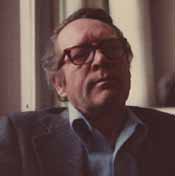
Patrick McGoohan in 1978. Photo: Roger Goodman
THE UNMUTUAL PRISONER SERIES GUIDE
THE GENESIS OF THE PRISONER
"It's so crazy, it might just work!".
This was
reputedly Lew Grade's reaction when Patrick
McGoohan first attempted to explain the basic premise of "The Prisoner"
to him. Little did Grade know that the series would become the most enigmatic
TV series ever produced. Still discussed and dissected nearly 40 years on, it
has stood the test of time perhaps better than any other series - with its themes
and ideals as relevent today, if not more so, than in the 1960s when the series
was produced. To begin our story of how this series came to be made, however,
we need to travel back to the North of England in the 1930s, where a young New
York-born Irish lad called Patrick McGoohan was growing up. When asked in 1983
when the idea for "The Prisoner" first came to him, he said:
"I'd always had, as a young child, this idea of a man in isolation. The
child in isolation. Anything in isolation. Being oppressed by the beaurocracy,
by the powers that be, with unfair rules, and unfair laws. Trying to beat their
minds into the shape that they wanted."
After leaving school at 16, training as a priest, and taking a succession of manual and administration jobs, budding actor Patrick McGoohan joined the Sheffield Repertory Company in 1947. Repertory, or rep as it was widely known, was the best-known "breeding ground" for actors at that time whereby during a particular week, a play would be performed during the evening, with rehearsals for next week's play taking place during the day (thus an actor would have two plays on his mind at any one time). From rep he moved to various provincial theatre companies before making his name in a succession of West End plays, including "Moby Dick" for influential film-maker Orson Wells. A moderately successful Film and Television career was soon building, including an appearance in the much-loved film "Hell Drivers", co-starring Stanley Baker, Sid James, Sean Connery, and William Hartnell. Then, in 1959, he was given a chance to play the role which would make him more than just another jobbing actor. Regarded as his finest performance, his portrayel of Ibsen's "Brand" on stage at Hammersmith and on Television for the BBC won him much acclaim. He appeared in a further selection of TV plays for both BBC and Granada. One of those, "The Big Knife" by Clifford Odets, brought him to the attention of Lew Grade.
Patrick McGoohan in 1978. Photo: Roger Goodman
Grade co-headed a prominent non-BBC broadcaster, Associated Television (ATV). Early successes for Grade and ATV included "The Adventures of Robin Hood" starring Richard Greene, "The Buccaneers" and "Sir Frances Drake". Although "The Adventures of Robin Hood" was shown on the CBS channel for three years, British shows were still not impacting on the US market as much as Grade had hoped.
In an attempt to improve this situation, ITC, a production arm of ATV, was set up to produce shows for the overseas market, with action/adventure series high on the agenda. In 1959, Lew Grade approached McGoohan (fresh from his role as "Brand") to take on the role of the lead character in a new half-hour action/adventure series - "Danger Man". The series and its lead character, that of a Secret Agent called John Drake, was created by producer Ralph Smart and appealed to McGoohan more than similar roles of that era (such as Bond and Simon Templar) as Drake was the hero "with no guns, and no girls", and he accepted the part. Years later, he would explain his "moralistic" view of television:
"One has a choice. If one wants to go out to the cinema and see horrendous things on the screen, do so. Go out, pay for it, and see it on the screen. But, I don't think they should have a place in the home."
Also accepting a prominent role in the new series was Assistant Director David Tomblin, who recalled "I met Patrick McGoohan on Danger Man when we did the first half-hour series, and we got on very well, struck up a good relationship". With McGoohan now becoming one of Britain's hottest stars, and future film-making at the forefront of both McGoohan's and Tomblin's ambitions, the pair formed Everyman Films Limited - under whose banner "The Prisoner" would eventually be made.
As part of the first location shoot for the new series, the "Danger Man" crew visited North Wales to film scenes for several of the early episodes. It was a location visit which would change McGoohan's life forever. McGoohan recalled:
"One of the locations was at a place called Portmeirion. I distinctly remember driving an Aston Martin down this little street and seeing this beautiful, and dreamlike, village - I was really astounded and wanted to find out more about it. I met Sir Clough Williams Ellis, the architect who designed it, and he talked at great length and showed me around, and told me about his dream........it came to me that it would be a marvellous place to make a movie."
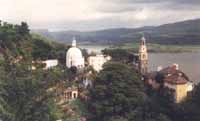
Portmeirion. Photo: Rick Davy
David Tomblin also recalled this visit:
"Oh yes. It was an amazing place - but I think the idea for The Prisoner came in retrospect. I don't know exactly how it came to pass, but it obviously stuck in his mind, and I think it tied up with some other things that he had been interested in over the years. And eventually they all came into one thought, and that is how we ended up on it."
Although early syndication of "Danger Man" to the US was not particularly successful (in the form of 39 half-hour episodes), a re-branding of the show's hour-long episodes as "Secret Agent" for the American market worked a treat and the show became the most successful British export to date, even out-popularising "The Saint", another popular ITC series (which starred Roger Moore as the womanising action hero Simon Templar). As "Danger Man" moved into its third series, George Markstein joined the team after a recommendation from future writer of "The General" Lewis Griefer, himself a script editor for ATV, in the role of script consultant. Markstein's knowledge of the world of spies and Governments, both through his work on shows such as "This Week" and "Stars and Stripes" and through his own wartime experiences, was to be invaluable to this, and the later series.
In all, Patrick McGoohan starred as Secret Agent John Drake in 80 episodes of "Danger Man" from 1959 to 1966. However, McGoohan had long felt that the storylines for "Danger Man" had become "repetitious and somewhat tired" and, in 1966, decided to call it a day. With George Markstein now in place as "Story Editor", the 4th season would be short-lived with "Koroshi" and "Shinda Shima" the only episodes, both of which were made in colour, to be made. Patrick McGoohan, effectively, resigned his position as John Drake and set his sights on producing his own films with Everyman Films - the collaboration between himself and Tomblin which had been set up some 6 years before.
Initially, McGoohan had wanted to produce a big-screen version of "Brand" (a project he would again attempt to resurrect, with no success, in 1968) but with Lew Grade aware of the public's thirst for what would these days be called "Cult ITC series", and McGoohan's "bankability", insisted that a better avenue for McGoohan and Tomblin's creativity would be an action/adventure TV series (in 26 or 39 parts to enable sales to the US and Canada). With McGoohan's "man in isolation" still in mind, he would later hand Grade a set of written pages, which Grade didn't read, and explained the idea. This was when Grade uttered the immortal words which head this page. The pair shook hands (McGoohan never once signed a contract with all his dealings with Grade), and "The Prisoner" TV Series was effectively born.
During the third season of "Danger Man", McGoohan himself became more heavily involved in writing but, to some extent, relied upon script consultant George Markstein to define the actor's ideas and turn them into more realistic scripts. Upon learning of the Everyman Films project, he joined McGoohan and Tomblin as Story Editor. Of particular interest to Markstein was an establishment called Inverlair Lodge, in Scotland, a "retirement home for spies" - an institution which would provide the template for the Prisoner's confinement, as Markstein later recalled:
"That
was the birth of the 'The Prisoner', people being sent somewhere and isolated
- I thought, let's make a series."
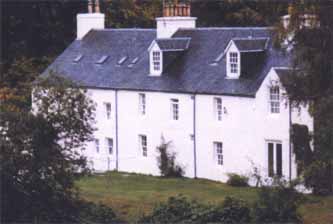
Inverlair Lodge. Photo: David Healey
Over the years, McGoohan and Markstein both claimed "ownership" of
the original "Prisoner" idea. "Prisoner" production manager
Bernard Williams, who worked on the later "Danger Man" episodes, has
always maintained that McGoohan was very much the creative genius behind the
series:
"George Markstein's is zero. God rest his soul, wherever he is. I shouldn't say it was zero, but it was Patrick McGoohan who created the idea, developed the idea, rejected lots of ideas, and he brought George Markstein in as story editor, who I believe got the credit, but it was undeserved, because Patrick was the guy who focused the series to where it was. He focused it, he remodelled it, he shaped it, and he told Markstein what to do."
Vincent Tilsley, who would go on to write two episodes, shared this view:
"Well, they all made claims for themselves, but no doubt McGoohan was the main force behind it all."
Markstein, however, always maintained that he came up with the idea whilst travelling on the 6.21 train from Shepperton to Waterloo. Whilst neither view can be ultimately proved to be the truth, it is undeniable that with Markstein's knowledge of the subject matter, McGoohan's "man in isolation" and allegorical ideas, and David Tomblin's eye for action/adventure film-making, the three main ingrediants for the creation of "The Prisoner" series were in place, and without any one of these facets the series would not have been made. Unfortunately, these ingredients would eventually prove to be incompatable and bring about the series' premature end.
With McGoohan, Tomblin, and Markstein fleshing out the ideas, Lew Grade contacted Michael Dann of the American PBS network, using McGoohan's name and images of Portmeirion, by now confirmed as the location of Markstein's "retirement home for spies", to sell the idea. It was undoubtadly a huge risk by Grade. At around £75,000 per episode, "The Prisoner" would be by far the most expensive British TV series yet made. Grade, however, was no stranger to risks - having made the brave step of introducing Italian baritone Tito Gobbi to a primetime UK audience in 1957 - a time when Lonnie Donegan was about as highbrow as commercial television dared to get.
With "Danger Man" now at an end, the crew who worked on the series effectively divided into two camps. As McGoohan was constructing his new series, alongside Markstein and Tomblin, a new ITC adventure series "Man in A Suitcase", created by "Danger Man" producer Sidney Cole and starring American actor Richard Bradford, had also been given the go-ahead by Lew Grade.
Along with stunt arranger and McGoohan double Frank Maher, many other members of the "Danger Man" production crew decided to stick with McGoohan, rather than join "Man in a Suitcase". They included Jack Lowin (Camera Operator), Brendan J Stafford (Director of Photography, who quit work on a US film for the chance to continue working with McGoohan - "All in all, The Prisoner asked more of my ability to interpret the mood of the script more than any of the other six hundred or so of the films that I photographed"), Jack Shampan (Art Director), Propsman Mickey O'Toole ("I struck up a kind of association with him as a drinking partner") and Director Don Chaffey (who was initially reluctant and only agreed to join when force-fed some early scripts by his daughter). Many of the other writers, Directors, and performers involved with "Danger Man" would also later take part in "The Prisoner". Also added to the team was Producer Leslie Gilliat, whom ATV viewed as a "safe pair of hands". As we find out later, Leslie's work on the series would be very short lived.
It was unknown, at this stage, as to whether or not McGoohan's "un-named ex-spy" who would form the main character of his new series was to be the same character, John Drake, who he had played for the 7 years previously. In the end, publicly at least, he had no choice anyway as Ralph Smart, who owned the rights to the Drake character, would not be involved in McGoohan's new series. McGoohan has always maintained that Drake and "The Prisoner" are not the same person;
"John Drake did not become The Prisoner. I know a lot of people think that, and it's understandable - i'd just finished with Danger Man, the fellow's name was John Drake and the next time you see him he's in this new series, pounding a table and saying "I resign" - but it was meant to represent anyone in a position where they had access to vital information of national importance, such as a scientist or a top government official or even a secret agent. But it was not necessarily per se that secret agent, he was never called John Drake - he just happened to look like him and he was called Number Six......As John Drake, one would have expected him to get out of that place as John Drake got out of every tough situation in 80 or 90 episodes."
George Markstein, however, took a different view:
"Yes, of course he was John Drake, but it's cheaper to have a number so you don't have to pay royalties."
With "The Prisoner" idea now realised, the task of preparing the series for production was next on the "to do" list.
Click
here to go to the next page of the Series Guide - Pre-production.